Friday, May 1, 2020

Trusting the Process

"Education cannot be effective unless it helps a child open up himself to life."  
-Dr. Maria Montessori
One of the wonders of Montessori education is the time given to the process. The freedom and flexibility to follow the student over the schedule. This translates to the time given to the formation of the child. Montessori children have a three year cycle to receive lessons, practice with the materials, and internalize new skills. And one could argue most Montessori children, in essence, have even more than three years seeing as Guides have countless lessons to provide scaffolding or additional challenge when needed. Its all about what is observed within the individual.

This concept of allowing the child time is not always easy to accept. Parents and teachers want their children and students to possess all the academic and social skills. And we want them to have these NOW. Am I right? Its easy to lose sight of whose path it truly is. But we must always bring it back to the child. We have to trust the process and know that young people learn on their own schedules, on their own time, and in their own ways. They will learn to read, become more proficient with their math facts, and build their writing skills. But if we push a child before they are ready, we create frustration. If we teach something too simplistic, we create indifference. Its only when we can allow the child to lead, to show us when they are ready to learn, that our goal can be accomplished.

Children want to take in all life has to offer. And they do! It's theirs for the taking, after all. By nature, children are open and ready to learn. Every day is something new. They want to know what new things are out there waiting for them to explore, to see and touch, to taste and smell. Sponges ready to absorb and soak in the world around them. Why? They trust the process.

Friday, April 24, 2020

Role of the Guide

"An adult can shape the environment, but it is the child that perfects his own being." 
-Dr. Maria Montessori
The role of the Guide in a Montessori classroom is different than that of a Teacher in a traditional classroom. A Teacher is at the center, where as Guide is there to observe. A Teacher makes plans based on curriculum standards and timetables first. A Guide has her albums ready, but pays attention to what lessons a child is truly ready for. A Teacher follows a schedule, while a Guide follows the child.

 Our job as Guides is to bring the child to the door, so close they might be able to peek in through the key hole, but then we are to leave them there. And when are ready, the child will open the door for themselves. This is the opposite of what mainstream education is built upon. When I was a traditional classroom teacher, I delivered information. But now as a Montessorian, I know it's not just about disseminating curriculum. Guides are trained to present impressionistic lessons, often through storytelling, to entice the child to want to go deeper into a topic of interest and learn more. The child is our teacher, Maria Montessori believed.

Its easy to feel overwhelmed by the amount of resources, suggestions, and advice on how to home school. But what our children are saying, and what they are displaying, should be most important. The children are still themselves. Laughing, playing, creating, imagining, learning. They have their moments of upset, frustration, and boredom. Sure. And all of these patterns and emotions are telling us good information. Helping us to understand what our children need next. The Guides are working tirelessly to help bring Montessori to your homes. But our answers can often be found within the children themselves. If they are happy, leave them be. If they are stressed, back up a little bit and let them breath. If children are asking for help, by all means sit with them. Like Guides, parents should not do the work for them. Most parents are not teachers and needn't pressure themselves to juggle this additional job. No. The child more often than not just longs to know we are there, supporting and encouraging them. Believing in them. A Guide has been trained to step out of the way of the child.  The child is wired to work and persevere. To try and fail and try again. The child is carving the path right now, and it is important that we, as parents, follow their lead. 

Thursday, April 16, 2020

The Planes of Development

"Our aim is not merely to make the child understand, and still less to force him to memorize, but so to touch his imagination as to enthuse him to his innermost core." -Dr. Maria Montessori
***
Dr. Montessori based her philosophy on four, distinct planes of development, or stages of learning. These are: Infancy, Childhood, Adolescence, and Maturity. Infancy is broken into two parts, The unconscious Absorbent Mind, from age 0-3, and The conscious Absorbent Mind, from 3-6 years. This is the "Help me do it myself" phase. Children here learn primarily through the senses. Childhood (The Reasoning Mind, ages 6-12), is the "Help me think for myself" plane. Here, we see exploration of ideas and information. Adolescence (The Humanist Mind, ages 12-18), is the "Help me think with you" section. It marks the transition from family to society. And finally, Maturity (The Specialist Mind, ages 18-21/24), where we find the "How can I help you" mindset. This final plane focuses on self-knowledge and self-realization.

Each plane has a very distinct set of characteristics which can be observed within the child. These characteristics can be physical, intellectual, emotional, or spiritual, and are what help to construct the individual. There is a range, of course, as each human being develops and learns in different way. Dr. Montessori made space for this in her three year cycles of education. She believed that children were always absorbing, taking in the world around them, and growing. 

And they still are. I promise you. Even today, when far away from their Montessori classrooms and working at home, our children are still learning. They may not have access to bead frames or checkerboards or pin maps. They may not be rolling out a rug to place their work on. They may not be using grammar boxes or metal insets. But they ARE learning. They are still working on their reading, writing, and math. They are still researching topics of interest and virtually exploring geography and cultures around the globe. They are playing outside more, enjoying art, and using their imaginations to create new games. They ARE learning. They are learning to adapt and be flexible. They are learning to be more independent and responsible. Today's learning may look and feel different to all of us. It may involve Legos or wooden blocks instead of traditional Montessori materials. Maybe we feel happy for the family time one minute, and then overwhelmed by the juggling act that is our new normal. Some may feel nervous about how all of this will effect our children long term. But I promise you, they ARE still learning.

Saturday, April 4, 2020

The Prepared Environment

“Education is a natural process carried out by the child and is not acquired by listening to words but by experiences in the environment.” 
-Dr. Maria Montessori
0007991.jpg (2362×1606)
The prepared environment is something unique and special to a Montessori classroom. Dr. Montessori designed work environments to encourage creativity, concentration, and independence. She believed everything should be beautiful for the child. Today, Guides spend countless hours sorting, organizing, and positioning various shelves and materials in the classroom before your child steps one foot through the door. And when the children do arrive, the responsibility becomes a shared one. The children, along with the teacher, work together to care for their sacred environment. Everything has a place and everything has order. 

Well, we are home now. So how do we replicate even a portion of this? We don't have room for separate Language, Math, Geometry, History, Geography, Science, or Practical Life shelves. But with some creativity, we can prepare a home environment that will indeed support the Montessori principles. 

If you can, designate a special area for your child to work. Ideally, it is separate from where the family eats or plays. It can be a small table or a corner of a room- that's enough. In our house, it took some rearranging, but our home school work area is clearly delineated from the rest of the house. Our materials are there and stay there. This sets the tone for work and is not accessed unless we are "at school". As we wrap our brains around the next few months, and are all looking at more time in our homes than usual, I encourage you to do some thinking about this. Discuss the options with your children. Together, make a list of items needed...paper, pencils, art supplies, books, etc. And they can brainstorm a few jobs to help care for their new home school environment...table washing, sweeping, or dusting, for example. The more you involve the children, the more connected and responsible they will feel. Go ahead! Move some furniture around, rearrange some shelves, or empty some baskets. Have a little fun finding what works for your family. 

The past several weeks have been a big adjustment and there wasn't much time to plan. We should give ourselves permission to pause and breath. Its not always easy, but the shift in mood that occurs when we allow ourselves to take a walk, play a game with our children, or to do something fun, is powerful. I have tested it myself. And when we remember to step back, we let in a growth mindset. And with this, we can prepare our home environments to best support the next few months of home learning. This sets up our children, and ourselves, for success.


Friday, March 27, 2020

Schedules

"One test of the correctness of the educational procedure is the happiness of the child." 
- Dr. Maria Montessori
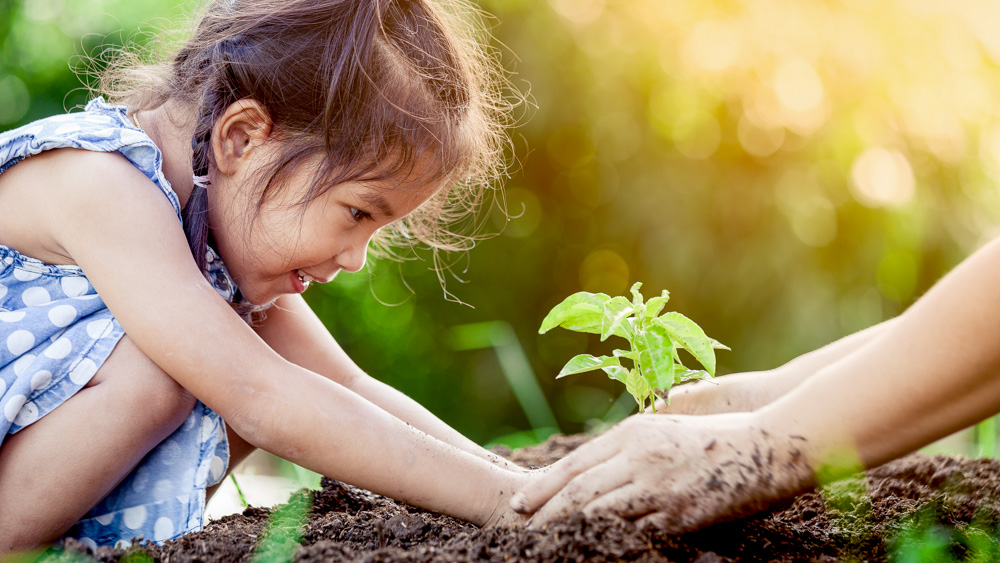
Image of young girl planting a plant in the forest. This connection encourages children to display more sustainable behaviors, which in turn gives them greater levels of happiness: Frontiers in Psychology
Last week we talked about Work Plans and how outlining a list of tasks each day is helpful. This encourages the child to prioritize their own work and responsibilities. But there is more we need to consider here. And that is OUR schedule. I don't know about you, but the lack of a clear beginning and end to OUR work day has been one of the hardest parts during this enormous transition. We are parents, professionals, parents again, trying to work again, and then parenting some more. No separation. Someone once said that when work comes home, home is what seems to suffer. Truth, right? Work is always there, calling us. And the children need us, too. How can we find our balance once again? How do we claim those boundaries for ourselves, our jobs, and our families? The answer I keep coming back to is a Weekly Schedule.

In the classroom, Montessori philosophy is all about structure, routine, and community. We are home now and those principles don't have to disappear. Whether you use a planner, a wall calendar, or your phone, we need to record our schedule for the week- and honor it. For me, the very act of writing something makes it feel more official. When does work start and end? Write it down. When do we take a break for lunch? Write it down. When can we help our children with school work and help facilitate their scheduled virtual class meetings? When can we check our emails or make phone calls? Write it down. And last, but certainly not least, when can we schedule self-care? Just as we tell our children to run around and play, we, too, need to heed this advice. To take walks, do yoga, read, or garden. If we don't model to our children the importance of caring for ourselves, how will they learn it? As parents, OF COURSE, we prioritize the happiness of our children. But, OUR happiness, our work-life balance, is important, too. And if we can stick to that schedule we create, in the end, everyone benefits.

Sunday, March 22, 2020

Shifting Gears

"The greatest sign of success for a teacher is to be able to say, "The children are now working as if I did not exist." - Maria Montessori
This past week was hard. Life as we once knew it, is no more and as a parent, it is easy to feel overwhelmed right now. I sure do. So many questions, fears, concerns, pressures from work, and academic resources flooding in at an astounding rate. It's a lot. But let's pause for a moment. Let's breath and validate ourselves. We did it. We got through. In fact, we did better than that. We succeeded. Our children are safe, content, and working on various tasks. It's easy to focus on the negative, or all that we didn't get done. But let's try and shift gears here. Let's hold our chins up high.

Everyone's home situation is going to be different during this unprecedented time and what works for the next person, may not work for you. And that is understandable. So how do we get through each week- each day- without feeling paralyzed? In the spirit of shifting gears, I will use this platform to help you bring Montessori into your home. You have more skills than you realize and are already sharing your many gifts. But, let me remind you that your job is NOT to sit and teach your child all day. You have work, life, and a whole slew of other responsibilities to tend to. So let's put some onus back on the child. The biggest goal of a Montessori education is independence. And your children are more than capable.

The key for all of us, children and adults, is routine. This starts with a schedule, or "Work Plan". Your children can look at their options and chart their own course for the day (see my daughter's plan above.) You can make one, too. Decide when you will do YOUR work and discuss with children that they have THEIR work to do as well. If you have times you are not available, put it on the schedule and set clear boundaries. Children can always read, practice math facts, draw, play games, go out in yard, and even (gasp!) watch cartoons while they wait for you.

We can't do it all. That is a never-ending battle, and one that we will not win. You have a lot of resources at your fingertips. Choose what works for YOU and push the rest aside. I can't stress that enough. Having a Work Plan helped me as a parent last week. This does not mean every day went perfectly. It did not. Some days will be better than others. Some days children will be motivated, while other days will feel like a struggle. As we shift gears, and find our new normal, I am working to practice patience and to extend some grace to my children... and myself. 

Sunday, March 8, 2020

Answering Big Questions


2019-nCoV-CDC-23312_without_background.png (1958×1966)

"We should help the child therefore no longer because we think of him as a creature, puny and weak, but because he is endowed with great creative energies, which are of their nature so fragile as to need a loving and intelligent defense." -Maria Montessori
***
Children have many questions, about many things. And it is our job to give them the information they seek, either by answering directly or finding someone else who can. We may sway them to a reference book or even an online source. Children want to know all of the why's and the how's. They want to know how the stars came to be or what the first human being was like. They want to know how stuffed animals are made or where our food comes from. And the Montessori child especially craves such answers, often in as much detail as possible. Don't shy away from answering your children's questions. They trust you and depend on you to help them to understand and make sense of complex ideas and things. It is important we answer on their level, of course, with honesty, but also with discretion depending on the age of the child and the topic. And the Coronavirus is no different. Many parents have asked me how I am talking to my students and my own children about this health emergency. Well, I am being honest. It is a flu-like virus that is making people sick all over the world and the best thing we can do is wash our hands often and keep away from those who are not feeling well. Yes, I mention that the Coronavirus has taken people's lives but that the threat to most of us is still quite low. Then I wait for their questions, and answer honestly and matter-of-fact. Below is a great video put out by BrainPop, an educational website where children (and adults) can learn just about anything via a short, animated film. My children are 12, 8, and 5 and it was a great starting point for a conversation. BrainPop - Coronavirus

Summer Montessori

"The greatest gifts we can give our children are the roots of responsibility and the wings of independence." -Dr. Maria Montessor...